Popular Posts

Showing posts with label 2012 Election. Show all posts

Wednesday, November 21, 2012

President Obama's Six Keys to Victory

Inside the multicultural, center-left coalition that ensured four more years

By Tim Dickinson
Progressive America Rising via Rolling Stone

President Barack Obama has won re-election – his lease on the White House renewed by a multicultural, center-left coalition that ought to give GOP consultants nightmares, producing an electoral college landslide that surprised everyone not named Nate Silver. (The Five Thirty Eight guru's reputation is as golden this morning as SuperPAC kingpin Karl Rove's is tarnished.)

With four more years, Obama can now cement his historic legacy, fully implementing Obamacare, the most ambitious renegotiation of the American social contract since the 1960s. The president broke ground on his second term with an electrifying acceptance speech that recalled the best of 2008's candidate Obama, and 2004's convention Obama. He hit again on the touchstone of his presidency, his belief "that while each of us will pursue our own individual dreams, we are an American family and we rise or fall together as one nation and as one people."

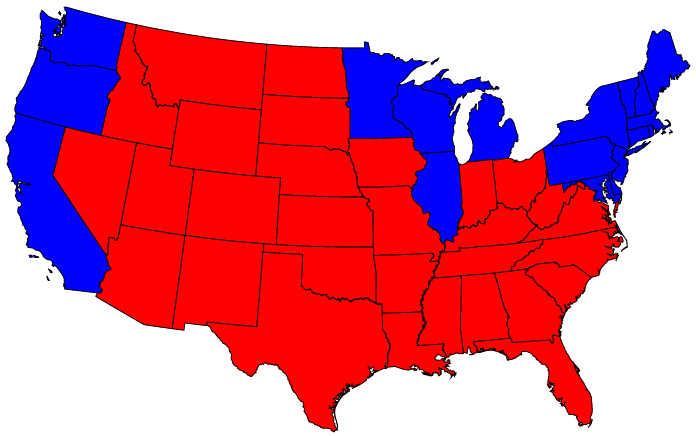
This race wasn't close. Obama secured a convincing win of the popular vote. And from his 2008 state-by-state haul, he surrendered only Indiana (which was never truly in play) and North Carolina (a surprise squeaker) to Mitt Romney. Every other swing state – Nevada, Colorado, Iowa, Wisconsin, Pennsylvania, Ohio, Virginia and New Hampshire – tipped again into Obama's victory column. When counting is complete, Florida, too, appears poised to go blue.

In the end, Obama's dedicated campaign volunteers proved themselves worth far more than anything the GOP's moneymen could buy. Voters rebuked the mendacious Romney and his villainous platform to lard the rich and destroy the social safety net.

How did team Obama defeat Romney? Here, the six keys to victory:

1) The Turnout Machine I reported on Obama's re-vamped get-out-the-vote machine this spring, previewing the technology that would enable the campaign to network its GOTV operations far beyond campaign offices and into the garages and dorm rooms of its supporters.

At the time, campaign manager Jim Messina and field director Jeremy Bird were making an early, unprecedented investment in the ground game – and that bet paid off like gangbusters. In a contest that couldn't compare to 2008's electricity, the 2012 Obama campaign reproduced – through brute force, dedication and will – a turnout in the swing states that in some cases bested the campaign's remarkable performance of four years ago. Yes, Obama lost North Carolina. But his final tally there was actually 35,000 votes greater than when he won the state in 2008.

2) Younger Voters Sorry, Boomer Nation: President Obama owes his second term to Generation Y. Voters under 30 turned out in greater numbers than senior citizens and broke for Obama over Romney 60-37. Gen X wasn't too shabby, either: Voters 30 to 44 gave Obama a 7 point edge. (Romney, on the other hand, won convincingly among voters 45 and older.) The numbers in Florida are particularly striking. According to exit polling, the Obama campaign not only improved turnout among the under-30 set there, it ran up the margin, too: Young Floridians broke 67-31 for Obama, better than the 61-37 margin over McCain in 2008.

3) The Latino Vote With 4 million more registered voters in 2012 than in 2008, Latinos accounted for one in every ten voters in 2012, and these voters broke for Obama by an epic 71-27 split nationally. That is almost exactly the margin Bill Clinton hung on Bob Dole in 1996, when there were only half as many Hispanic votes. Messina told me earlier in the campaign that he was "obsessed" with the Latino vote, and that reproducing Clinton's numbers against Romney this year would mean Game Over for the Republican. He was absolutely right – particularly in Colorado, where the split was even more lopsided: 75-23, up from 61-38.

4) African-Americans The historic turnout of African-Americans from 2008 held steady in 2012 at 13 percent of the electorate, nationwide. And the Obama campaign actually managed to increase black turnout in pivotal states like Virginia, where one in five voters was African American. Romney earned only 5 percent of that vote, compared to the 8 percent won by John McCain.

5) Ohio Working Stiffs Call it the "Let Detroit Go Bankrupt" factor. In Ohio, where the auto industry employs one in eight workers, Obama actually gained ground – 2 points – among high-school educated voters without college degrees, about a quarter of the state's electorate. Compare that to Wisconsin, where Obama lost 6 points among this cohort. Or North Carolina, where the dropoff was 11 points.

6) All the Single Ladies Romney was haunted by a yawning gender gap, particularly among unmarried women, who accounted for 23 percent of voters (up three points from 2008). While Romney himself took awkward pains to reach out to female voters, he was yoked to his running mate's moves to redefine rape, and to the GOP's broader agenda to limit access to not only abortion but birth control. Obama took this voting bloc by a 67-31 margin, nationally, and by nearly identical tallies in Ohio and Paul Ryan's home state of Wisconsin. The intersection of race and gender was especially powerful for the president in states like North Carolina, where black women accounted for 14 percent of the electorate – and 99 out of 100 voted to defeat Mitt Romney.

Wednesday, November 14, 2012

How the Left Can Become a True Political Force to Be Reckoned With

By Bill Fletcher & Carl Davidson
Progressive America Rising via Alternet.org

Nov 13, 2012 - The 2012 elections may prove to have been a watershed in several different respects.  Despite the efforts by the political Right to suppress the Democratic electorate, something very strange happened: voters, angered by the attacks on their rights, turned out in even greater force in favor of Democratic candidates. The deeper phenomenon is that the changing demographics of the USA also became more evident—45% of Obama voters were people of color, and young voters turned out in large numbers in key counties.

Unfortunately for the political Left, these events unfolded with the Left having limited visibility and a limited impact—except indirectly through certain mass organizations—on the outcome.

The setting

On one level it is easy to understand why many Republicans found it difficult to believe that Mitt Romney did not win the election.  First, the US remains in the grip of an economic crisis with an official unemployment rate of 7.9%.  In some communities, the unemployment is closer to 20%.  While the Obama administration had taken certain steps to address the economic crisis, the steps have been insufficient in light of the global nature of the crisis.  The steps were also limited by the political orientation of the Obama administration, i.e., corporate liberal, and the general support by many in the administration for neo-liberal economics.

The second factor that made the election a ‘nail biter’ was the amount of money poured into this contest.  Approximately $6 billion was spent in the entire election.  In the Presidential race it was more than $2 billion raised and spent, but this does not include independent expenditures.  In either case, this was the first post-Citizen United Presidential campaign, meaning that money was flowing into this election like a flood after a dam bursts.  Republican so-called Super Political Action Committees (Super PACs) went all out to defeat President Obama.

Third, the Republicans engaged in a process of what came to be known as “voter suppression” activity.  Particularly in the aftermath of the 2010 midterm elections, the Republicans created a false crisis of alleged voter fraud as a justification for various draconian steps aimed at allegedly cleansing the election process of illegitimate voters.  Despite the fact that the Republicans could not substantiate their claims that voter fraud was a problem on any scale, let alone a significant problem, they were able to build up a clamor for restrictive changes in the process, thereby permitting the introduction of various laws to make it more difficult for voters to cast their ballots.  This included photographic voter identification, more difficult processes for voter registration, and the shortening of early voting.  Though many of these steps were overturned through the intervention of courts, they were aimed at causing a chilling impact on the voters, specifically, the Democratic electorate.[1]

So, what happened?

Prior to the election, we argued that what was at stake in the 2012 elections was actually the changing demographics of the USA (along with a referendum on the role of government in the economy).  What transpired in the elections was very much about demographics.

The percentage of white voters dropped from 74% to 72% between 2008 and 2012.  Romney received 59% of the white vote.

Yet something else happened and it took many people by surprise.  Despite the intimidation caused by the voter suppression statutes—and the threatened actions by right-wing groups—African Americans, Latinos and Asians turned out in significant numbers, voting overwhelmingly for the Democrats.[2] 93% of African Americans went with Obama, as did 71% of Latinos (which represented an increase over 2008) and, despite the fact that Asians are only 2-3% of the electorate, they went 73% in favor of Obama (which was a jump from 62% in 2008).  The youth vote, by the way, increased to 19% of the electorate, over 18% in 2008, and went overwhelmingly for Obama.  Labor union members went for Obama at a rate of 65%, and unions themselves played a major role in many key states in terms of voter mobilization.  By the strategic mobilization of these voters in a well-organized ‘ground game,’ Obama won 332 Electoral College votes compared with Romney’s 206.  Obama’s popular vote total was also 2.6% head of Romney.

The Romney/Ryan camp was entirely unprepared for this.  While it is the case that the popular vote total was not overwhelming for Obama, there was nothing particularly unusual in US history for such a result.  The bottom line is that Obama clearly won both the Electoral College vote and the popular vote and, as such, can claim a mandate for his next steps.

It is important that one understands that the African American/Latino/Asian turnout, along with the long-lines waiting to vote (including in the days of early voting) represented an audacious defiance of the forces that sought to suppress the vote.  This audaciousness also represented a response to the increasingly racist attacks on Obama, attacks that were taken very personally by people of color generally and African Americans in particular.[3]

What was equally interesting about the November 6th elections were those in the House of Representatives and the Senate.  Contrary to many expectations, the Democrats not only held onto the Senate, but slightly increased their margin of control.  Within that expansion was the election of Elizabeth Warren from Massachusetts to the seat once occupied by the late Teddy Kennedy.  Warren, who gained a strong reputation in the fight to control Wall Street, promised actions on behalf of working people.  Independent Senator Bernie Sanders, a socialist in Vermont, also decisively won reelection.

In the House of Representatives, Democrats increased their totals, but Republicans still dominate.  This is mainly the result of the gerrymandering carried out by Republican state legislators during redistricting.  The legacy of this gerrymandering may last at least a decade, part of the fallout which resulted from lower voter turnout combined with the Republican mobilization in the 2010 midterm elections.

Of particular note in the elections was the increased presence of women, especially progressive women, being elected to office, including the first openly gay Senator (from Wisconsin, Tammy Baldwin).  The state of New Hampshire now has women in all of the top governing positions.

Additionally several progressive ballot initiatives passed in various states, including on same-sex marriage and the decriminalization of marijuana.  An interesting initiative in the state of Michigan to alter the state constitution in order to protect the right of workers to collective bargaining was defeated after a major and concerted attack by pro-employer groups.

What to make of the elections?

We return to our earlier conclusion, i.e., that what was at stake in 2012 was not Obama’s record but instead 2012 was a referendum over demographics and the role of government with the far right.  Some on the Left found this assertion worthy of ridicule rather than introspection, and dismissed it, claiming that of course Obama’s record was central to the debate.

The results of the election conform much more to our conclusions.  The vote for Obama, particularly by people of color, could not possibly have been the result of the conclusion that Obama’s record made him the great leader.  Certainly his record was better than the interpretation projected by Romney/Ryan, but it was also the case that Obama’s record was complicated if not problematic.  After all, we had witnessed an economic stimulus that, while significant by historical standards, was insufficient to the task; a healthcare reform package that, while bringing healthcare to millions, was based on a corporate model first elaborated by Mitt Romney when he was Governor of Massachusetts; a failure to close Guantanamo; the continuation and escalation of the Afghanistan/Pakistan war, including the usage of drone strikes; and the failure to adopt a clear policy to address systemic racial injustice in the USA.  While there were a number of reforms that were introduced that were of significance, this was all far less than most of Obama’s supporters had hoped would be introduced.

So, what then could one say motivated the vote? We return to demographics and the role of government.  Obama’s very existence represents the problematic future for the political Right; it’s not that he’s an individual whose birthplace is alleged by them to not be in the USA.  This insane propaganda from the Birther movement is designed to distort the point entirely.  The Birthers[4] and their off-spring hate Obama not because of where he was born but because he was born here.  His very existence illustrates the changing demographics of the USA and its move away from being a ‘white republic’ governed by a broad ‘white’ front. Instead, we are moving more towards something else, toward a more openly multi-ethnic/multi-racial society, if not politically then at least numerically.

The election thus represented a repudiation of the right-wing irrationalists seeking to turn the clock back, and not just on race, but gender and class as well.  In this sense it was not so much about what Obama had accomplished as it was about what sort of society 61 million people did not want.  That retrograde society, which was rejected, was a neo-apartheid order of domination that condemned at least 47% of the population (according to Romney’s calculations) to marginalization, and condemned at least 90% of society to continued economic distress and submission.

Romney was proposing to reduce the role of government even further, at least when it came to supporting something approaching a social safety net.  61 million people recognized the barbarism contained in his message and program, and responded accordingly.

In sum, the November 6th elections were not a referendum challenging Obama’s course from the Left, but rather rejecting a challenge from the Right, since there was no viable Left alternative.  At the same time there was an additional interesting feature of the elections as identified in various opinion polls: Democratic voters, while not as starry-eyed as many were in 2008, are looking for Obama to fight for them, or at least fight on their behalf.  Frustration with Obama’s premature compromising in the name of so-called bi-partisanship wins the President few accolades within his base.  The electorate is looking for something very different.

The Left in the elections: Building mass organizations vs. the mouths that screeched

Contrary to those who suggest that no Left exists in the USA, it is better to understand that there are two and a half Lefts in the USA.  There is the organized Left, which takes the forms of very small political organizations, some of them calling themselves political parties, which are anti-capitalist and generally for some sort of socialism.  There is also what Chilean Marxist Marta Harnecker would describe as the “social movement Left,” which are forces involved in left-leaning mass organizations and non-profits, more often than not single-issue or based within a specific sector.  There is finally what we could term the ‘half’ Left, that is, the ‘Lone Rangers,’ the rather large number of independent individuals who self-identify as leftists but are unaffiliated with any left-wing project, with the possible exception a job with social impact, such as writers or teachers or health care workers.  In each case these individuals and formations are anti-capitalist and seek a social transformation of the USA, but with varying degrees of organization, insurgency and effectiveness.

The US Left has historically had a difficult time addressing electoral politics.  There are several reasons--the complications that arise from the undemocratic nature of the US electoral system; the size of the USA; the lack of attention to strategy; and most important, ambivalence when it comes to race.  As a result the Left frequently sways back and forth between what could, perhaps, be described as apocalyptism on the one hand (i.e., waving the red flag so that the masses see us before the whole system collapses and, therefore, they know where to go), to reformist/incrementalism, on the other (i.e., believing that the best that can be done is to submerge into the Democratic Party and help move change until the system reaches a point where quantitative change morphs into qualitative change).

There is currently no significant and unified effort within the Left(s) toward building a self-conscious, broad radical Left project that has the objective of winning power.  The bulk of the US Left does not think politically.  Rather it engages in ideological or moral struggle and often thinks that ideology or morality is identical to politics.  Rather than conceptualizing a protracted struggle for power based on the need to build a majoritarian bloc, too many individuals and organizations on the Left remain trapped in a self-satisfying world of small sects and Facebook tirades rather than the hard work of building the alliances of grassroots groups necessary to win.

The limitations of the Left’s approach to the fight for power can be illustrated in any number of places, but, for the moment, let’s reflect upon the electoral realm.  Consider the following.  In 1920 Eugene V. Debs ran, for the fifth time, for the Presidency.  Though in jail at the time (as a result of political repression), he received nearly one million votes.  In the famous 1948 campaign of Progressive Party candidate Henry Wallace, the candidate received 1,157,328 votes and no Electoral College votes.  In the same election, Dixiecrat candidate Strom Thurmond received more popular votes and 39 electoral votes.

Now, in 2012, Green Party candidate Jill Stein received 402,125 votes.  This is going the wrong way.  But it reflects, more than anything, not the character of Stein or her supporters but the approach toward electoral politics taken by the Green Party and many of their followers.

Independent presidential candidacies in the modern era reflect what can be described as a flag-waving/protest mode rather than a struggle for power/bloc-building mode.  In other words, they aim to express both outrage and reasoned critique at the system and frustration with the toxicity of democratic capitalism.  They have no hope of gaining power either because they do not believe in struggling to gain power or because they believe that power is gained when the ship sinks and we, on the Left, are positioned in the proper lifeboats prepared to save the mass of distressed passengers.

This is only on the electoral side.  The various small organizations of the organized Left which do not engage in electoral politics in their own names seem relatively content being small and of little consequence.  In the absence of an effort at building a majoritarian bloc they can remain comfortable in their particular niche(s) and not feel the cold winds that often accompany entering into unexplored demographic or geographic territories. They remind us of the old Clifford Odet’s play, ‘Waiting for Lefty.’

At the same time, over the last 5-10 years there has developed a new interest in electoral engagement in the social movement Left.  Sprouting up in different parts of the USA have been progressive—rather than explicitly Left—political formations that have either engaged in what has come to be known as “civic engagement” work, i.e., voter registration, education, voting rights, electoral law reform, and/or actual electoral engagement.  The strength of this work is that its orientation can be described as left/progressive in that these are mass-based projects attempting to reach out to a broad array within our natural base.  Organizations ranging from Progressive Democrats of America to the Virginia New Majority and Florida New Majority fall into this camp, though the list is quite a bit longer than just these organizations.

In the lead up to the 2012 elections the Left was badly divided over how to respond.  One segment, which we will describe as the “mouths that screeched” were adamant that Obama had betrayed progressives; that he was not progressive; that he represented the empire; and therefore not only should not be supported but that it was ideological treason to suggest any level of support or even just to give him a vote without any implied support.

The vitriolic attacks coming from this sector masked the fact that this segment of the Left is actually becoming irrelevant.  They had no visible impact on the elections and their protests were largely ignored.  Unfortunately, one of the key things that this segment missed was the racial element of the 2012 elections and the need for voters of color, along with a good number of white allies, to push back at the ‘demographic’ attacks that were underway from the political Right.  By focusing on all that Obama did incorrectly, this segment of the Left ignored, as well, that the Left and progressives are on the strategic defensive in the USA and that they need alliances that will provide some level of space within which we can operate.

The segment of the Left that actually made a difference was those within the organized Left and the social movement Left who engaged their mass organizations and non-profits in electoral activity.[5] Whether it was voter registration; voter education efforts; electoral infrastructure work; or Get Out The Vote efforts, many of these organizations proved themselves to be very effective campaign organizations.  They appear to be in the process of laying the groundwork for the sorts of progressive alliance building that will be necessary to respond to the next electoral realignment that hits the USA.

What is missing entirely, however, is a coherent, self-identified Left, taking either the form of a united front, alliance, or political organization that can serve as a pole for independent, radical yet grounded Left politics.  The mass base for such an effort exists.  The opinion polls that demonstrate that roughly one third of the population are open to directions other than capitalism means that approximately 90 million people are seeking alternatives.  Consider that 90 million figure when you review the stats for the Green Party’s votes in 2012.  The Occupy Movement also evidenced a political fissure that is certain to widen as the class struggle intensifies, though admittedly Occupy did not result in the formation of one or several credible Left organizations (no criticism implied).

Moving forward

The challenge for the Left then becomes two fold.  One, there must be a self-identified, self-aware, mass radical Left formation that openly and unapologetically advocates against capitalism and for environmentally friendly socialism.  Whether such an organization is called a political party, alliance or some other name is secondary to what it must do and what it must avoid.  What it must avoid is the idea that it can or should compete in the electoral realm on the presidential level at this time. That is a no-win scenario.  What it can do, however, is to unite and train the existing leaders in mass movements and develop an anti-capitalist program and ultimately an anti-capitalist project.  We term this notion of a new, self-conscious and organized Left—inspired by the approach taken by and expression used by Italian Marxist Antonio Gramsci—to be the “Modern Tecumseh.”[6] Second, the Left can also help to build a progressive front—perhaps a popular front against finance capital that unites disparate forces—that gains electoral expression in the form of an organization (rather than a third party) that runs candidates within the Democratic Party or, runs them independently if conditions exist (such as in Vermont where the candidacy and leadership of Senator Sanders needs to be supported).

As long as the progressive forces in the USA are on the defensive there will be tactical alliances that take place that are not satisfying but are nevertheless necessary.  These should not be treated as matters of principle but rather as expressions of necessity of the moment.  Further, we on the Left must pay much greater attention to what is transpiring among the people themselves.  The fact that so many on the Left would have focused on Obama’s record and virtually ignored the intense racist offensive against Obama (and its broader implications) demonstrated that many of our friends are out of touch with reality.

Reality, however, is a good and necessary starting point if one ever wishes to build a majoritarian bloc and win power. We fully expect to see an intensification of class struggle in the near term. We need to assert a new culture of organizing capable of meeting the demands it will place on us, and now is the time to begin.

[1] The issue of voting rights remains critical since there are cases before the U.S. Supreme Court to challenge critical features of the 1965 Voting Rights Act, features that were part of the Department of Justice’s arsenal to overturn certain voter suppression legislation.

[2] It is important to note, however, that voter turnout was down in comparison to 2008 except for nine states.  As of this writing it is not clear as to the sources of the decline.

[3] Attacks such as Donald Trump’s insulting demand that President Obama turn over his college transcripts.  The suggestion of such an action is almost unbelievable.  Nothing along those lines would have been tolerated when it came to former President George W. Bush, an individual who was not half the student that was Obama in college.

[4] The right-wing, irrationalist political movement that asserts that Obama was not born in the USA and is, therefore, not the legitimate president of the USA.

[5] To be clear, not all forces in the organized Left or the social movement Left engaged in left/progressive electoral organizing.  We are simply noting that there were forces from within these sectors that did, in fact, choose to engage.

[6] Tecumseh: Shawnee leader in the first decade of the 19th century.  Recognized that Native Americans would never defeat the USA by fighting as individual tribes or fighting through the creation of a confederation.  He was the advocate for a Native American nation-state, i.e., uniting the tribes and fusing their efforts.  He was killed in 1813 at the Battle of the Thames in Canada.

Bill Fletcher, Jr. is a racial justice, labor and international writer and activist.  He is a Senior Scholar with the Institute for Policy Studies, the immediate past president of TransAfrica Forum, an editorial board member of BlackCommentator.com, the co-author of Solidarity Divided, and the author of the forthcoming “They’re Bankrupting Us” – And Twenty other myths about unions.  He can be reached at billfletcherjr@gmail.com

Carl Davidson is a political organizer, writer and public speaker. He is currently co-chair of Committees of Correspondence for Democracy and Socialism, a board member of the US Solidarity Economy Network, and a member of Steelworker Associates in Western Pennsylvania. His most recent book is New Paths to Socialism: Essays on the Mondragon Cooperatives, Workplace Democracy and the Politics of Transition.’ He can be reached at carld717@gmail.com.

Wednesday, November 7, 2012

Beginning Again: Assessing Obama's Victory

By Tom Hayden
Progressive America Rising

Nov 6, 2012 - President Barack Obama addresses a crowd of supporters in Chicago, IL, following his reelection on November 6, 2012.President Barack Obama’s triumph was, in the first place, one of brilliant organizational execution built on the changing demographics of America. Obama never lost sight of his community organizing lessons, nor the harder ones of Chicago politics. His volunteers, looking at fewer numbers and less enthusiasm, turned themselves into a relentless machine. David Axelrod and David Plouffe kept the focus of resources on the battleground states while the Republicans, torn by a long primary war, were left behind vying for crucial electoral votes.

Obama’s triumph was also one for the rising political bloc of Latinos and their younger generation of Dreamers, who asserted themselves as an indispensible force in coalition politics; a breakthrough for the long-isolated LGBT community; for a resurgent feminist community called back into action; and above all, for a unified African-American community absolutely determined to be at their president’s back.

Obama’s triumph demonstrated, too, a popular mandate for a positive vision of government’s role in protecting workers, consumers and the disadvantaged against the storms of an economy controlled by the One Percent, as embodied in the election of Elizabeth Warren in Massachusetts. The decision to attack Romney on Bain Capital and Wall Street issues was a conscious choice by the Obama team to go populist – against the counsel of such key Democrats as Bill Clinton, Cory Booker and numerous others.

Less clearly but still compellingly, it was a mandate to continue advancing toward a green economy. The political aftershock of the super-storm is only beginning to be felt, but it must lead to Green Keynesianism.

The causes of marriage equality and marijuana legalization have advanced through popular initiatives.

Sadly, many angry white radical critics of Obama may have isolated themselves even further from this enthusiastic popular upsurge. Reading their intense blogging and listening to their rage on Pacifica, one almost had the sense that they there were disappointed in Obama’s success. A quick survey indicates that third party candidates failed to make any difference whatsoever in the elections in battleground states.

The problem of their increased isolation is unfortunate because an organized, popular, effective radical presence is needed within mainstream civic society. Those progressives entirely devoted to Obama will be hard-pressed to separate themselves from the president in the wake of this exhausting and emotional campaign. But crunch time is at hand for the AFL-CIO, the NAACP and the liberal coalition as the “fiscal cliff” approaches.

How will Obama balance his progressive electoral mandate in negotiations with the Republicans, which begin almost immediately? Who will take up the battle against Citizens United and forcefully point out the connection between the super-storm and the full-scale arrival of global warming? Can Occupy Wall Street – or any radical organizers – recover from their apparent disdain for strategies which involve electoral politics and pressure? Is there anyone within the political establishment – Warren, Tammy Baldwin, Bernie Sanders? To forge an inside-outside alliance with the party of the streets? What issues will MSNBC choose to take up?

On foreign policy, the crisis over Iran intensifies almost daily. Obama has few options unless there is an overwhelming popular opposition to the nearing war. American troops are withdrawing from Afghanistan, but their path is a rocky and ragged one. The drone wars drone on. Latin America remains devastated by the Drug War, NAFTA-style economics, and toxic residues of the Cold War. There are few in Congress to take up these burning issues. But diplomatic, political and economic solutions are needed more than ever to the crises of the Long War, drone and cyber-warfare, and the violence of the Middle East and Arab Spring.

For more details, please see also by Tom Hayden, “Obama’s Legacy Is Our Leverage.” Article originally appeared on tomhayden.com (http://tomhayden.com/). See website for complete article licensing information.

Saturday, October 27, 2012

White Racial Resentment: The Elephant in the Room

AP Poll: A Slight Majority of Americans Are Now Expressing Negative View Of Blacks

By Associated Press
October 27, 2012

WASHINGTON — Racial attitudes have not improved in the four years since the United States elected its first black president, an Associated Press poll finds, as a slight majority of Americans now express prejudice toward blacks whether they recognize those feelings or not.

Those views could cost President Barack Obama votes as he tries for re-election, the survey found, though the effects are mitigated by some people’s more favorable views of blacks.

Racial prejudice has increased slightly since 2008 whether those feelings were measured using questions that explicitly asked respondents about racist attitudes, or through an experimental test that measured implicit views toward race without asking questions about that topic directly.

In all, 51 percent of Americans now express explicit anti-black attitudes, compared with 48 percent in a similar 2008 survey. When measured by an implicit racial attitudes test, the number of Americans with anti-black sentiments jumped to 56 percent, up from 49 percent during the last presidential election. In both tests, the share of Americans expressing pro-black attitudes fell.

“As much as we’d hope the impact of race would decline over time ... it appears the impact of anti-black sentiment on voting is about the same as it was four years ago,” said Jon Krosnick, a Stanford University professor who worked with AP to develop the survey.

Most Americans expressed anti-Hispanic sentiments, too. In an AP survey done in 2011, 52 percent of non-Hispanic whites expressed anti-Hispanic attitudes. That figure rose to 57 percent in the implicit test. The survey on Hispanics had no past data for comparison.

The AP surveys were conducted with researchers from Stanford University, the University of Michigan and NORC at the University of Chicago.

Experts on race said they were not surprised by the findings.

“We have this false idea that there is uniformity in progress and that things change in one big step. That is not the way history has worked,” said Jelani Cobb, professor of history and director of the Institute for African-American Studies at the University of Connecticut. “When we’ve seen progress, we’ve also seen backlash.”

Obama has tread cautiously on the subject of race, but many African-Americans have talked openly about perceived antagonism toward them since Obama took office. As evidence, they point to events involving police brutality or cite bumper stickers, cartoons and protest posters that mock the president as a lion or a monkey, or lynch him in effigy.

“Part of it is growing polarization within American society,” said Fredrick Harris, director of the Institute for Research in African-American Studies at Columbia University. “The last Democrat in the White House said we had to have a national discussion about race. There’s been total silence around issues of race with this president. But, as you see, whether there is silence, or an elevation of the discussion of race, you still have polarization. It will take more generations, I suspect, before we eliminate these deep feelings.”

Overall, the survey found that by virtue of racial prejudice, Obama could lose 5 percentage points off his share of the popular vote in his Nov. 6 contest against Republican challenger Mitt Romney. But Obama also stands to benefit from a 3 percentage point gain due to pro-black sentiment, researchers said. Overall, that means an estimated net loss of 2 percentage points due to anti-black attitudes.

The poll finds that racial prejudice is not limited to one group of partisans. Although Republicans were more likely than Democrats to express racial prejudice in the questions measuring explicit racism (79 percent among Republicans compared with 32 percent among Democrats), the implicit test found little difference between the two parties. That test showed a majority of both Democrats and Republicans held anti-black feelings (55 percent of Democrats and 64 percent of Republicans), as did about half of political independents (49 percent).

Obama faced a similar situation in 2008, the survey then found.

The AP developed the surveys to measure sensitive racial views in several ways and repeated those studies several times between 2008 and 2012.

The explicit racism measures asked respondents whether they agreed or disagreed with a series of statements about black and Hispanic people. In addition, the surveys asked how well respondents thought certain words, such as “friendly,” ‘’hardworking,” ‘’violent” and “lazy,” described blacks, whites and Hispanics.

The same respondents were also administered a survey designed to measure implicit racism, in which a photo of a black, Hispanic or white male flashed on the screen before a neutral image of a Chinese character. The respondents were then asked to rate their feelings toward the Chinese character. Previous research has shown that people transfer their feelings about the photo onto the character, allowing researchers to measure racist feelings even if a respondent does not acknowledge them.

Results from those questions were analyzed with poll takers’ ages, partisan beliefs, views on Obama and Romney and other factors, which allowed researchers to predict the likelihood that people would vote for either Obama or Romney. Those models were then used to estimate the net impact of each factor on the candidates’ support.

All the surveys were conducted online. Other research has shown that poll takers are more likely to share unpopular attitudes when they are filling out a survey using a computer rather than speaking with an interviewer. Respondents were randomly selected from a nationally representative panel maintained by GfK Custom Research.

Overall results from each survey have a margin of sampling error of approximately plus or minus 4 percentage points. The most recent poll, measuring anti-black views, was conducted Aug. 30 to Sept. 11.

Andra Gillespie, an Emory University political scientist who studies race-neutrality among black politicians, contrasted the situation to that faced by the first black mayors elected in major U.S. cities, the closest parallel to Obama’s first-black situation. Those mayors, she said, typically won about 20 percent of the white vote in their first races, but when seeking reelection they enjoyed greater white support presumably because “the whites who stayed in the cities ... became more comfortable with a black executive.”

“President Obama’s election clearly didn’t change those who appear to be sort of hard-wired folks with racial resentment,” she said.

Negative racial attitudes can manifest in policy, noted Alan Jenkins, an assistant solicitor general during the Clinton administration and now executive director of the Opportunity Agenda think tank.

“That has very real circumstances in the way people are treated by police, the way kids are treated by teachers, the way home seekers are treated by landlords and real estate agents,” Jenkins said.

Hakeem Jeffries, a New York state assemblyman and candidate for a congressional seat being vacated by a fellow black Democrat, called it troubling that more progress on racial attitudes had not been made. Jeffries has fought a New York City police program of “stop and frisk” that has affected mostly blacks and Latinos but which supporters contend is not racially focused.

“I do remain cautiously optimistic that the future of America bends toward the side of increased racial tolerance,” Jeffries said. “We’ve come a long way, but clearly these results demonstrate there’s a long way to go.”

___

AP News Survey Specialist Dennis Junius contributed to this report. 

Online: Poll results: http://surveys.ap.org Academic analysis: http://tinyurl.com/8pzbebm

Monday, October 22, 2012

Statement From Leonard Peltier on Voting

'The Effort the Started with Obama's Election Should Continue'

WhoIsLeonardPeltier.info
October 21, 2012

Greetings my relatives and supporters of freedom everywhere,

I don’t know how many of you read my statements; but if you are looking for someone who thought about what he was going to say before he said it, I’m your man. People in my situation have a lot of time for thinking, and I try to catch the media as much as I can. Having said that, I would like to take just a minute of your time, maybe two minutes of your time and convey to you my thoughts on voting.

Our people, native people, were not citizens of this government until 1924. And because of our resistance to encroachment and our fight for sovereignty many of our people have a tendency to not vote because they don’t consider this government our government. And in growing up I must admit I was in the same frame of mind, but as I’ve aged and experienced different aspects of life and come across many other philosophies, I’ve realized that in some ways I’ve had kind of a tunnel vision view of the subject of voting. And I now recognize that we sincerely need to vote. Whether we embrace our own level of sovereignty or not or whether you are native American or not. If you are an American you need to vote.

There’s an old saying its better to redirect force than to fight force with force. This government is a force, this is a force throughout the world and with our vote, we can redirect that force. Tecumseh the first native person to advocate a coalition of all the tribes, said in a talk once, as I’ve read, he demonstrated that one arrow could be broken but a bundle could not. That is how it is with voting, one of us doesn’t go very far, but all together as a voting bloc, we make a strong force to redirect this force of this government. And if our arrow becomes one of a bundle of others who are seeking justice and equality in government, then its entirely possible that we can make a difference. And this would make a difference in the world.

Obama, being elected, was in its own way like the tip of an arrow in revolution. It was an effort by a multitude of people recognizing the need for this country to be more humanitarian toward other members of society than it has been. And it was an effort by the people to choose someone who cared about the people and was not just there for political power and monetary gain. I really truly believe this effort that started with Obama’s election could continue. Anyone who understands any level of government would know that this present administration could not totally clean up the mess that was created over a period of time, 8 years to be exact, under the Bush Administration. If you were old enough to remember things started to change when Ronald Reagan was in office and they started to break down labor organizations who kept up with workers’ rights and safety legislation as well as environmental legislation. And that trend has been going up and down ever since and if those powers elect another person of the Bush or Reagan mindset, it will hasten the downfall of this country’s economic situation – which until the Obama administration was in free fall. Its slowly working its way out, but we as a people need to do our part to help with that and we can do it by voting.

I also want to say, that the prison system in America has become an industry. It has become a bureaucracy. And in whatever state you live you need to become involved in changing that. The rate of imprisonment and incarceration of men and women is indescribably tragic. The rate of recidivism is somewhere between 65% and 85%, failure of the prison system, people coming back to prison. If you were needing health care, you would not be going to a facility that has a

65 to 85% failure rate. Any prison system that does not consider rehabilitation as a component is unjustifiable. Also the federal government and the state government needs to set up a system for people who manufacture American products to get an incentive of some sort to do that and put more Americans back to work.

It is a fact that I can’t vote, nor can any of the other 2 million people in prison in America can vote and countless others who have felony convictions. I want to say there a lot of people throughout this country who should not have felony convictions and should not have lost or lost their right to vote. Most of these people come from poor families who would normally vote Democratic. And the powers that be, that control this country, mainly corporations, know this. And I believe with this prison industry, as well with other systems they have in place, it is all part of the control mechanism to subjugate Americans, of all races and colors. The judicial system in America needs a massive overhaul. The constitution is no longer the foundation of this judicial system. It is no longer the plumb line of law. If all of us who care, and want to see change go do this one thing, we can successfully redirect the force of this nation. We must do this or we will succumb to the wealthy corporations that want to use us as poorly paid wage slaves to fund their lavish lifestyles.

Anyway, maybe I’ve held you too long, but think about what I’ve said, and I know theres a lot more information out there than I have. And you with your vote can do a whole lot more than I can in here, or the other 2 million people that are locked up. Exercise your right to vote. Get your family to vote, organize voting drives. Don’t let the corporations control us any longer. Don’t let the prison system remain an industry in America. If you’ve never attended a demonstration or a political rally or any other function that tried to bring light to an injustice you can at least do this one thing, vote. I don’t know how to close out this comment other than to say, “vote, vote, vote.”

And may the Great Spirit bless you with all you need and enough to share and the courage to do whats right and right whats wrong

Your relative, brother, friend and fellow citizen of the first nations, In the Spirit of Crazy Horse and Tecumseh and all those people who have stood for whats right, Leonard Peltier

Sunday, October 21, 2012

Get Out the Vote. Especially Women, Youth and Trade Unionists. It Matters…

New Poll Puts Presidential Race As A Dead Heat Between President Obama And Mitt Romney

NBC News calls it a 47-47 tie

By Glenn Blain
NEW YORK DAILY NEWS

Oct 21, 2012 - The race for the White House is a dead heat.

An NBC News/Wall Street Journal poll released Sunday showed President Obama and Republican challenger Mitt Romney tied at 47% with barely two weeks to go before election day.

Obama had held a 49-46 lead among likely voters in the most recent previous NBC/WSJ poll, which was conducted before any the presidential debates.

The new poll revealed Obama with a wider lead among all registered voters, 49% to 44% but showed his support weakening in key demographics.

Among women voters, Obama's lead had slipped to its slimmest margin yet this year, 51% to 43%. Romney leads among men 53%-43%. Mitt Romney lost some ground gained by first debate, according to polls, but still doing strong.

The two candidates are essentially tied among voters in the Midwest.

"You saw those numbers a moment ago, I think they are only going to get better," Florida Sen. Marco Rubio, a Romney supporter, said on NBC's "Meet The Press."

Obama supporters, meanwhile, shrugged off the numbers, saying they expected a close race.

"We feel good about where we are," said David Axelrod, a senior adviser to the Obama campaign. "We feel we are even or ahead in these battleground states." From NYDailyNews.com   

Local interview with Paul Ryan ends abruptly Saved by a hug: Baby Adam’s coma story Candidate's son apologizes for urging voters to send Obama back to Kenya Obama still a fan of Clint Eastwood despite chair speech: President praises 'great actor' after… Clint Eastwood’s daughter says she's not backing Mitt Romney

Sunday, October 14, 2012

Republicans Out of Touch with Reality—And What We Can Do

By Bill Fletcher, Jr.
Progressive America Rising via Precinct Reporter Group

I saw this astounding figure that approximately 70 percent of Republicans believe that the poll numbers on the presidential race are biased towards President Obama.  In other words, they are asserting that because President Obama has been—at least at the time of this column—ahead in most polls, this cannot be correct and the media must be mucking around.

It is important to put this sentiment in context.  This is the same Republican Party where more than 60 percent of its members believe that President Obama was not born in the U.S. Despite the incontrovertible evidence, most Republican voters wish to believe otherwise.  I would love to think that this was a comedy routine but it is reality.

To understand how 70 percent of Republicans would believe that the polls are biased, you have to appreciate their inability to recognize the nature of the changes underway in the country.  To the extent to which they believe that this is a ‘White republic,’ where the rest of us are barely-tolerated visitors, the polls don’t make any sense.  After all, from their perspective, there is no way that the U.S.A. should have a Black president, and, more importantly, there is no way that the demographics of the U.S.A. should be changing in the manner in which they are – towards a society where there is no White majority.

There is no way of knowing how the elections will turn out. The fact that President Obama has been ahead in most polls is striking, particularly given the depth of the economic crisis.  Such ratings have to indicate that large numbers of people have little confidence in the vision articulated by Romney/Ryan, but also that there is a sense when looking at the pictures of the Republican National Convention in Tampa, that this gathering (and this Party) bore no resemblance to the reality of the nation.  It looked like something very alien and for that matter, something very scary.

While President Obama may be slightly ahead in the polls, the only poll that really matters is to be held on November 6 when we actually vote.  Despite all of the efforts by the Republicans to reduce voter turnout by the elderly, the youth, by people of color, by union members and by gays/lesbians, the bottom line will be the determination of those same constituencies that were not in evidence at the Tampa Republican Convention to mobilize in the interest of justice.  This will take us further down the road, away from the racist and archaic notion of a ‘White republic’ (for the rich), and instead in the direction of a more consistent democracy.

Forget the opinion polls and just make sure to vote on November 6.

Bill Fletcher, Jr. is a Senior Scholar with the Institute for Policy Studies, the immediate past president of TransAfrica Forum, and the author of “They’re Bankrupting Us” – And Twenty Other Myths about unions.  He can be reached at papaq54@hotmail.com. Submit to Facebook Submit to Google Bookmarks Submit to Twitter Submit to LinkedIn Written by: Precinct Reporter Group

Thursday, October 11, 2012

Can We Defeat the Racist Southern Strategy in 2012?

By Bob Wing*

Progressive America Rising

*Bob Wing has been an organizer since 1968 and was the founding editor of ColorLines magazine and War Times/Tiempo de Guerras newspaper. He lives in Durham, N.C. and can be contacted on Facebook. Thanks to Max Elbaum for his always insightful suggestions. This article was posted on Oct. 11, 2012.

The 2012 election is a pitched battle with race at the center.

It may not be “polite” to say this, but far from an era of “post racialism”, the United States is in a period of aggravated racial conflict. Though often denied and certainly more complex than the frontal racial confrontations of the past, race is the pivot of the tit-for-tat political struggle that has gripped the country for the past twelve years and, indeed, for decades prior.

The modern era of this conflict jumped off with the white conservative backlash against the Voting Rights Act of 1965 and has been deepened by their decades-long fearful reaction to the dramatic change in the color of the U.S. that resulted from the civil rights-motivated immigration reform act of 1965.

The conflict heated to a boil when white conservatives flatly rejected the legitimacy of the “premature” victory of our first Black president in 2008. Nearly 40 percent of Republicans are so enraged they cannot even admit that Obama is a U.S. citizen. Isn’t this really another way of saying they refuse to recognize a Black man as the president? Or perhaps it is the white conservatives’ modern day Dred Scott decision declaring Obama a Black man that has no rights that they are bound to respect?

The bottom line is that we have now come to a point where voters of color are so numerous and so united behind Obama that, to be victorious, Mitt Romney must carry a higher percentage of the white vote than any modern Republican candidate has ever won. If recent trends among voters of color hold, he must carry about 63 percent of white voters. Not even Reagan won more than 61 percent.

The likelihood is that voters of color will continue to increase their percentage of the electorate by about two percent per election into the future. Political analyst Jonathan Chait concludes it is “2012 or Never” for the current bloc of white conservatives. (1) This is why they invested hugely in voter suppression legislation throughout the country (now largely but belatedly defeated by the courts. (2) This is why they have gone all out to unleash corporate money in elections.

Chait warns that the “2012 or Never” scenario for white conservatives suggests that if the Republicans win, they will be all-in for “Blowing up the welfare state and affecting the largest upward redistribution of wealth in American history.” This is the meaning of the rise of the Tea Party and the choice of Paul Ryan as Vice President.

On the other hand an Obama victory in 2012 on top of that of 2008 has the potential to mark an historic turning point U.S. politics: the defeat of the Republican’s powerful Southern Strategy by which the Republicans have dominated U.S. politics since Richard Nixon’s stunning victory in 1968. The heart of that strategy is to build a winning coalition based on racial fear and backlash in the South, the Southwest and Rocky Mountains. This strategy is rooted in slavery so it is no accident that the Electoral College map of 2004--and most other post Voting Rights maps--is a virtual replica of the pre-Civil War map of slave states and territories.

Free and Slave Territories Before the Civil War

clip_image001


clip_image003

clip_image005        

clip_image006clip_image004


clip_image004[1]


clip_image007


clip_image008


Electoral College Map of 2004 Election

clip_image010

Compare these to that of 2008 when Obama defeated the Southern Strategy and carried four Southern and three Southwestern states, and took back Ohio, Iowa and Indiana.

Electoral College Map of 2008 Election

clip_image012

One hundred and fifty years after abolition, the scars of slavery are fresh upon us and we are fighting the contemporary Civil War.

The defeat of the Southern Strategy could create a major turning point in U.S. politics. It could mean the end of the white rightwing led Republican majority that has prevailed since 1968. And it could herald the potential, for the first time since the 1970s, of a more progressive future for people of color and other poor and working people.

However white racial conservatives in the U.S., especially the U.S. South, have no history of giving ground without protracted and intense struggle. Their 2010 comeback was the latest example. Although 2012 might be a turning point, we can expect intense racial conflict well into the future.

What is the Southern Strategy?

When all looked lost for the Southern segregationists after the Voting Rights Act of 1965, rightwing Republican political strategists concocted the Southern Strategy to crush the Civil Rights movement and reverse its victories. To the shock of just about everyone at the time, the seemingly dead and buried Richard Nixon rode the white backlash and the Southern Strategy to the presidency in 1968, the high point of the radical movement of the 1960s. Worse, the seemingly defeated and isolated Dixiecrats revived themselves and over the last few decades acceded to a greater political role that they had enjoyed since before the Civil War.

Since then the Strategy has been refined and updated, and brilliantly implemented, by Ronald Reagan, the Bushes and a host of Republican and rightwing political operatives like Lee Atwater, Ralph Reed and Karl Rove at all levels.

Wikipedia says the Southern Strategy “refers to the Republican Party strategy of winning elections or to gain political support in the Southern section of the country by appealing to racism against African Americans....In an interview included in a 1970 New York Times article, he [former Republican strategic Kevin Phillips] touched on its essence:

‘From now on, the Republicans are never going to get more than 10 to 20 percent of the Negro vote and they don't need any more than that...but Republicans would be shortsighted if they weakened enforcement of the Voting Rights Act. The more Negroes who register as Democrats in the South, the sooner the Negrophobe whites will quit the Democrats and become Republicans. That's where the votes are. Without that prodding from the blacks, the whites will backslide into their old comfortable arrangement with the local Democrats.

Historically, the Democratic Party was the party of Southern slaveholders that dominated the Republic from its founding until the victory of the new Republican Party of Abraham Lincoln in 1860. After the Civil War the white South voted so uniformly Democratic the South was dubbed the “Solid South.” Even when the Democratic Party transformed itself into the party of the center/left during the New Deal, the Southern segregationists were powerful enough to force the Democrats to leave Jim Crow racial discrimination and segregation intact. In return they stayed loyal to the party.

The Republicans had virtually no presence at all in the South until the Democrats began to take civil rights seriously due to the pressure of the new Freedom Movement of the late 1950s.

Like the Civil War, the Civil Rights revolution of the 1950s and 1960s caused an historic realignment in U.S. politics.

Defeated, the boldest and most conservative Republican strategists concocted the Southern Strategy as the political roadmap to crush the then triumphant Democratic coalition of liberals, blacks and trade unions and return the white South to glory. It has succeeded beyond their wildest dreams.

The crux of the strategy was to whip up the white racial backlash to the Civil Rights victories and the newly powerful black movement, and on that basis to realign to the Republicans the historically Democratic white South and other white Bible Belt conservatives in the former slave and Mexican territories of the Southwest, Midwest and Rocky Mountains. By popularizing newly sanitized versions of color blind racism and Christian fundamentalism, the new Republicans hoped to trump whatever class affinities and progressive impulses working class and poor whites had with the Democrats and get them to organize and vote Republican on the basis of white racial solidarity.

It was not the moderate Rockefeller-type Republicans of the early 1960s who organized these new recruits, but an ambitious new crop of far right ideologues. The mass migration of racial and Christian conservatives from the Democratic Party to the Republicans became the organized base of the far right. The Southern Strategy gave birth to New Rightism and the Christian Coalition, flanked by the “Right to Life,” a newly revived and politicized National Rifle Association, the suburban homeowners revolt and fiscal conservatism, not to speak of a new level of militarism. Their strength was redoubled by northern plant closures and capital flight from unions which turned the South into a dynamic demographic and economic growth center.

To be fully successful, this strategy required the leadership and funding of the majority of the corporate elite. After leaning Democratic from the New Deal to the 1960s, this elite lurched to the right when their formerly secure monopoly profit position came under intercapitalist challenge from Germany and Japan, the USSR, and the rise of the Global South led by the oil-producing countries and other former colonies starting in the 1970s. To protect their profits they set out to lower wages, eliminate regulations, crush unions, lower taxes on themselves, starve the social safety net and move their operations to the low wage south or out of the country.

This rightward moving corporate elite financed and, until recently, was the leading force in the new Republican coalition. And it was their alliance with the grassroots racist and fundamentalist backlash that gave power to the Southern Strategy.

The other big piece of this new Republican majority coalition was recruited from the affluent suburbs created by white flight throughout the country since the 1960s. The homeowners’ tax revolt became their battle cry. Even in the South the main social base of the far right Republican politicians is the affluent suburbs, not the stereotypical unreconstructed white small town or rural segregationists.

The post-Civil Rights Republican coalition has always been rife with factions and differences, but despite changing leaders and tactical emphases, it has held strong enough to defeat the Democrats. The Republicans have also used their newfound power to fragment and marginalize the main institutions of their opposition such as civil rights and immigrant rights groups, trade unions, reproductive rights and other feminist organizations, trial lawyers, students and journalists.

With each victory the Republican coalition became “dizzy with success” and migrated further and further to the right. The Ross Perot-led revolt of the political center in the 1990s heralded a loosening of the grip of white conservatives over the political majority and temporarily threw the presidency to Bill Clinton. Under George H.W. Bush the program of extreme trickle down economics and war mongering brought the country to crisis and was grist to the mill of Democratic challengers. Now they threaten Social Security, Medicare and public education.

Since 2000 the country has been rocked by tit for tat pitched political battles between this extreme rightist Republican Party and a Democratic party that finally senses victory. The Southern Strategy is in trouble.

The Changing Color of the Vote and the Southern Strategy

At a deeper level the Southern Strategy is imperiled by a combination of structural/demographic in the electorate and political changes in voting patterns.

The structural changes are that people of color and unmarried women now occupy much larger shares of the electorate than before, and continue to grow. The political factor is that the rightward lurches of the Republicans (e.g. stolen 2000 election, War on Terror starting 9/11 and 2009 Tea Party) have ignited the people of color vote. Black people in particular have mounted a real voter participation movement, and people of color are together voting Democratic in historically unprecedented numbers and percentages.

Despite the fact that George W. Bush had failed miserably on both foreign policy (Iraq) and domestic policy (the Great Recession) and run the country virtually into the ground, in 2008 whites still voted for McCain by 55 to 43. In stark contrast, blacks voted for Obama by 95 to 4, Latinos went for Obama by 66 to 32 and Asians backed Obama by 61 to 35. (3)

More importantly, people of color have surged to the polls in recent years. In 1976 they constituted just 10 percent of the vote; 24 years later, they had almost doubled to 19 percent in 2000. By 2008 the white share of the vote fell to 74 percent and that of voters of color spiked to 26 percent, a dramatic change in such a short time.

______________________________________________________________________________

Chart of Changing Electorate and Changing Vote


Election

2000

2008


Black %


10%


13%

Black Vote


90D-9R


95D-4R

Latino %


8%


9%

Latino Vote


62D-35R


66D-32R

Asian %


2%


2%

Asian Vote


55D-41R


62D-35R

Other Race % (4)


n/a


3%

Other Race Vote


n/a


66D-35R

White Male %


39%


36%

White Male Vote


36D-60R


41D-57R

White Female %


42%


39%

White Female Vote


48D-49R


46D-53R

______________________________________________________________________________

Surprisingly, the recent increase is not being driven by the burgeoning Latino or Asian populations, but by African Americans. Despite modest population growth and a horrific percentage of people barred from voting due to felony disenfranchisement laws, Blacks constituted fully thirty percent of all new voters in 2004, and another tremendous mobilization in 2008 brought them to 13 percent of the overall vote, a thirty percent increase over 2000.

This is strong evidence that Blacks continue to be the most politically progressive section of the electorate.

Many a pundit has dismissed this result as a knee-jerk racial solidarity vote for Obama. How soon they forget that the majority of black voters initially favored Hillary Clinton over Obama and that the pop in black voting began long before the 2008 contest.

A growing majority of African Americans live in the U.S. South. That region may be the heartland of white racial conservatives, rightwing corporate types and militarists, but it was also Jesse Jackson territory. Blacks have the greatest stake in defeating the Southern Strategy, and have moved to the forefront of that struggle. Indeed, contrary to Yankee stereotypes, the region is extremely diverse and a more nuanced analysis is key to progressive strategy.

Although the sheer numbers of Latino and Asian voters have risen significantly over the same period, their percentage share of the overall vote is little changed since 2000: from eight to nine percent for Latinos and two percent each election for Asians. (The percentage of the electorate that is under thirty years of age also remained stable, at 17-18 percent.)

The Civil Rights-inspired immigration reform act of 1965 finally eliminated racial discrimination from U.S. immigration policy and opened the way for an explosion of Asian and Latino immigration.

The Latino population now outnumbers that of African Americans and continues to surge due to high birth rates and immigration. This population increase is slow to be translated into voting power, largely because so many Latinos are ineligible to vote. However, according to Sean M. Rivas, California State Field Director of Voto Latino, “Every month 50,000 Latino youth turn 18 – that’s 600,000 Latino youth turning 18 every year.”

Latino voters have already transformed California politics and are likely to do the same to national elections in the years to come. Traditional conservative strongholds like San Diego and Orange County, the home bases of Ronald Reagan and Richard Nixon, are now blue areas. And although Latinos only slightly increased their percentage of the presidential electorate since 2000, they doubled from 1996 to 2008, from 5 to 10 percent of all voters.

Much of the mainstream media declared that Latinos were too racist to vote for Obama. They pointed to the large Latino primary vote for Clinton as “proof.”

Latinos resoundingly put the lie to these cynics by voting for Obama by 66 to 32, a huge sixteen-point swing to the Democrats compared to 2004. Even a 58 percent majority of Cubans in Florida, traditionally solidly Republican, went for Obama.

Latinas led the way toward Obama, casting 68 percent of their votes for him and only 30 percent for McCain. Latino voters under 30 went for Obama by 76 to 24, perhaps indicating the direction of future Latino voting patterns.

As with the South, progressives need a more accurate picture of the rapidly changing Southwestern political and economic landscape. Still, most Latinos still live in the region despite their nationwide migration of recent decades. The fight for equality for Latinos is totally bound up with the defeat of the Southern Strategy.

According to a Pew Research Center report of June 19, 2012, “Asians recently passed Hispanics as the largest group of new immigrants to the United States.” Numbering barely a million when the Asian American movement kicked off in 1968, by 2011 they were 18.2 million strong, encompassing a dazzling array of nationalities.

Asians strike a contradictory voter profile. Of all ethnicities, they have the lowest percentage of eligible voters (due to a lack of citizenship). Among eligible voters, they also have the lowest rate of voter registration. But Asian registered voters occupy the ballot in greater percentages than any other group. Also a greater percentage of Asian voters than any other ethnic group are registered non-partisan.

The political trajectory of Asian voters has also been remarkable. In 1992, only 31 percent of Asians cast their ballot for Bill Clinton. Responding to the rightward motion of the Republicans since then, especially as regards immigration and foreign policy toward Asia, Asian Americans have migrated Democratic. This reached a highpoint in 2008 when Asians voted for Obama 62 to 35, a fourteen point Democratic swing compared to 2004.

In the coming years millions of Asians will become eligible to vote not only in traditional strongholds like California and New York, but also Illinois, Texas and many other states. Asian political organizations and candidates are popping up all over the country, even in Georgia, to encourage, educate and leverage these new voters.

Unmarried Women Voters and the Gender Gap

The highest percentage of the white vote won by any Republican presidential candidate was 61 percent. The recent high-water mark was that of George W. Bush’s 58 percent in 2004. He “took” the election in 2000 when he carried 55 percent and whites were 95 percent of his total vote. McCain also won 55 percent, but was swamped by Obama due to a huge increase in the people of color vote.

For decades white feminist pundits have touted the gender gap as the defining feature of U.S. politics and society. However, to be more precise, Linda Burnham has show that there is no significant gender voting difference among people of color--and the majority of white women vote Republican. (5) It is arguable that income differences are a greater voting factor than gender among whites.

However, women now constitute a small majority of the overall vote, and by race and gender, white women are the single largest voter group, 39 percent in 2008. Even a small gender gap can therefore be of great political moment.

In 2008 white men favored McCain by 57 to 41 while McCain won the white women vote by 53 to 46. This is only a four-point difference, and takes place within the Republican column. The recent voting trends among white women voters are also not good. In 2004 they blundered to Bush by an additional seven points compared to 2000 and were in fact the decisive factor in his victory that year. And in 2008 they edged towards Obama by only four points, less than the swing of white men. After years of splitting down the middle, white women have tilted toward the Republicans since 2004.

Democrats and progressives must reverse this trend if they are to defeat the Southern Strategy once and for all. And there is a major new trend among women that has a unique potential to move the white women vote leftward: the rise of unmarried women voters.

Unmarried women now account for fully half of all women in the U.S. and along with Latinos is the most rapidly growing potential voter group. The group has grown due to the fact that women are marrying at an older age than before, the divorce rate is extremely high and more women than ever are remaining single for life. Exit polls do not sufficiently break down the vote to get a read on the voting patterns of unmarried white women, but in 2008 exit polls showed a seven point Democratic differential between all single women and all married women. It is likely that a good part of that differential can be explained by race, since African American women are a disproportionate percentage of unmarried women. But recent polls show even greater Democratic leanings by unmarried women than in 2008 and indeed among women in general.

The problem is that 39 percent of unmarried women are currently not registered to vote and are significantly outvoted by more conservative married women. However this growing group represents a major opportunity for Democrats and a major demographic/political threat to Republican electoral fortunes.

What Might a 2012 Victory Mean?

A 2012 victory by Obama is far from guaranteed. A loss would mean we will have hell to pay as the Republicans will likely seize what may be their last opportunity to implement the ominous Paul Ryan program.

What might the defeat of the Southern Strategy in 2012 mean?

A full and final defeat would mean the end of the historic period of extreme white conservative leadership stemming from the remnants of slavery. However, conservative Southern whites have time and again shown a tremendous will to survive, and even if they are defeated again in 2012, they cannot be counted out as a powerful factor in U.S. politics.

Exit polls after the 2010 election indicated that forty percent of voters supported the Tea Party. This year seventy percent of Republican primary voters shunned Romney in favor of far right candidates like Newt Gingrich and Rick Santorum. Far right politicians dominate the Republican congressional delegation and have taken an “Our Way or the Highway” approach to lawmaking. Although their ability to command a national majority is in doubt, the far right is probably stronger than it has been in recent memory.

A 2012 defeat would likely cause them to lose some support from moderate corporate Republicans who are much more committed to having power than they are to the rightwing program, but other sectors are likely to continue or even redouble their support. The far right can also be counted on to lead or shape many state and local governments for decades to come.

A declining superpower like the U.S. is fertile ground for the rightwing. As I noted in “The Arab Spring and the Changing Dynamics Global Struggle,” the world is in a dangerous transition from a U.S. centered economy and politics to a more equal but unstable and uncertain future. World and national migration is changing the face of the U.S. and Europe, and the far right will continue to try to inflame and capitalize on white fear of the changing power dynamics at home and abroad. Peak oil and climate change are upon us, and fights over natural resources and “natural” disasters have accelerated. Technology and conflict make terrorist attacks a daily reality. Protestants have declined from two-thirds of the population to less than half, and almost all of the losses have been among whites. (6) The far right will try to take advantage of the instability, frustration and fear that attend these changes.

Still, a 2012 victory by Obama would throw the far right onto the defensive, inflame and infect already deep divisions within the Republican Party, block the full implementation of Paul Ryan’s draconian budget and reduce the possibility of deadly wars of choice. It might also moderate the Federal bench and protect ObamaCare and maybe Social Security. Of course Republican congressional moderates might reemerge and seduce Obama into a Faustian austerity bargain.

A victory in 2012 should open new vistas for the Democrats at the national level and in an increasing number of states and localities. The Democrats should be able to make steady gains well into the future. It would also create new opportunities for the development and maturation of an independent progressive wing within the Democratic Party.

In such a situation, agenda item number one will be to further split the far right from the center and to defeat their agenda in public opinion as well as Congress. The far right was able to strengthen itself and regain the ideological offensive in the face of the passage of historic health care reform and will retain that kind of potential. In addition the U.S. electorate is largely fiscally conservative and moderate, including many Obama voters. Indeed non-partisan voter registration, overwhelmingly centrist, is at an all-time high. Many moderate Democrats, probably including the Obama administration itself, will surely take this as a call to stay safely in the pro-corporate but moderate center.

There is certainly merit in some caution, but unless the Democrats take the initiative, the Republicans will continue to set the public agenda and shape public opinion. We are still vulnerable to a replay of 2010. However, the Democrats are unlikely to be bold without the emergence of a powerful national political force to the left of the Obama administration that can tussle with moderate Democrats as well as help anchor the fight with the right.

Toward a Progressive ‘New Majority’ of the  Rising American Electorate’

In recent years progressives have grown more united, more organized, more aggressive and strategically smarter. We are occasionally able to gain initiative (opposition to the War in Iraq, Wisconsin, Occupy) but we have not yet become a consistent and undeniably powerful force in national politics or even within the Democratic Party, two crucial and mutually interconnected tasks. In addition the traditional sources of progressive power—civil right organizations, trade unions, feminist groups, and liberal churches, universities, student groups and media organizations—have been greatly weakened over the decades in the face of corporate and rightwing attacks and policy changes.

Progressive have recently achieved wide agreement and increased working unity on the crucial importance of electoral politics and forging an independent progressive wing of the Democratic Party, though some on the far left still harbor abstentionist or third party dreams. Progressives and social justice forces are experimenting with bold new strategies and initiatives. (7) MoveOn.org, Progressive Democrats of America, Rebuild the Dream, Planned Parenthood, Take Back America, Wellstone Action, the Working Families Party, many unions and social justice groups like the NAACP, Virginia New Majority, California Calls, Florida New Majority, Oakland Rising, TakeAction Minnesota, Kentuckians for the Commonwealth and Maine People’s Alliance are on the move with ambitious new agendas and increased unity. We are also beginning to orchestrate and coordinate our work inside and outside of the electoral and governmental arenas.

New coalition strategies are also being proposed. One of the most promising is the concept of the New Majority which has been adopted by people of color-led groups by that name in Florida, Virginia and New Mexico. I think the New Majority concept has great potential because it casts a spotlight on the need to realign new forces into a governing coalition and suggests a pivotal role for people of color, just as I have in this essay.

However, I also believe that a progressive New Majority strategy should not fall into the fatal trap of relying almost exclusively on voters of color. People of color are projected to become a majority of the U.S. population by about 2040. But they will not be a majority of voters anytime soon because so many Latinos and Asians will continue to be ineligible to vote for decades to come. For every 100 Latino residents in the United States, only 44 are eligible voters. Although people of color became the majority of the California population twelve years ago, today they still constitute only 34 percent of the electorate.

And even if or when voters of color become the majority, the divisions among them are likely to deepen. Political and social divisions along the lines of race (many Latinos are racially white) and ethnicity (including the growth of mixed race folk), economic status, ideology, age, gender and sexuality are already marked and deepening.

Consequently the quest to win white people to a progressive coalition is crucial. White progressives are not temporary or tactical allies of people of color, they are strategic partners. Too many progressives, especially on the social justice left, white and non-white, downplay or obscure this fundamental strategic and practical necessity.

Another intriguing progressive strategic concept is the Rising American Electorate. The Rising American Electorate refers to voters of color, unmarried women and young voters. These voters are estimated to be the fastest growing part of the electorate as well as the most politically progressive. Indeed the argument is made that they constitute more than half of the eligible electorate and that therefore they should be the main target of massive voter registration, education and mobilization efforts into the future. (8)

The usefulness of the Rising American Electorate concept is that it is specific about which sectors of the population we might focus on to build a progressive New Majority. However, I would supplement it with this: many people of color and unmarried women also make up a big part of an important and even larger group: the poor (working and non-working) and the struggling middle class.

Since 1970 the U.S. corporate elite’s economic strategy has produced increasing inequality which, among other things, has split the unusually large and stable middle class of the 1950s and 1960s between the truly affluent and the struggling. It has also increased the number of poor, including working poor. These voters largely vote Democratic, but the Republicans have intercepted a section of de-classed white working class voters to their side and thereby cut into the former New Deal/Great Society working class coalition. Progressives can only be successful in the future if we win increasing numbers of these voters back.

This newly deindustrialized, financialized and unequal economic structure has cut deeply into union membership. But is has also energized and moved unions to the left compared to the many decades when the labor movement was dominated by the conservative building trades. The largest, most dynamic and most powerful unions are now the SEIU, AFSCME and others that represent more minority, lower paid and less stable sectors of the working class. They have adopted more progressive policies on health care, immigrant rights, organizing the unorganized and other issues that reflect this. And finally they are starting to show signs of working with other sectors of the progressive movement in real partnerships.

Although weaker than before, it is hard to imagine a powerful progressive force to the left of Obama without a revitalized and dynamic labor movement.

Deploying a class/economic lens on the population and the society is also important from an ideological and programmatic point of view, as dramatically illustrated by the power of the 1% slogan popularized by the Occupy Movement. Even the Obama campaign has essentially adopted it. Particularly in a historical period when inequality is deepening among all people and when economic divisions are growing among people of color and women, it is crucial to weave race, class and gender together. Adding a class perspective also lessens the possibility of dividing over racial or gender identities. Indeed, in this period of great economic instability, the fight for economic justice is front and center.

Another positive sign is that in recent years many social justice groups are busting out of complacent small group thinking and fearlessly moving on to the big fields of battle. Caring Across Generations, initiated by social justice groups National Domestic Workers Alliance and Jobs with Justice, has formed a giant labor, senior, community alliance to defend Social Security and Medicare while simultaneously organizing new workers and winning passage of Domestic Workers Bills of Rights at the state levels. New Bottom Line led by social justice community networks National Peoples Action, the Alliance for a Just Society and PICO, have united with labor and others to take on the banks. And in the electoral field numerous social justice groups which I named before are fighting for real electoral power and running candidates and initiatives rather than confining themselves to non-partisan voter registration and Get Out the Vote.

**************************

There are huge stakes in the 2012 election. A defeat would be disastrous but a victory would be a major blow to the Southern Strategy and the power of white conservatives. A full political turn will require progressives to massively step up our game inside and outside of the electoral arena not only in 2012 but in the years to come. Isolating the far right and building the progressive movement must go hand in hand. If we can make some headway on these twinned tasks, we have a chance to emerge as a real force in national politics in what are sure to be perilous and volatile times shaped by demographic transition, imperial decline and environmental crisis.

_____________________________________

Footnotes

(1) Jonathan Chait, “Team Romney’s White Vote Push,” Daily Intel, Aug. 27, 2012.

(2) Ethan Bronner, “Voter ID Rules Fail Court Tests Across the Country,” NY Times, Oct. 2, 2012.

(3) Voter statistics and commentary for the 2000, 2004 and 2008 elections can be found in my earlier articles on those contests which can found through Google. The statistics are from the single national exit polls of those years.

(4) It is impossible to determine exactly who identified as “Other Race” in 2008. If many Latinos chose this identity in the exit poll it may mask a significant additional rise in the Latino vote.

(5) Linda Burnham, “No Mandate from Women of Color,” www.commondreams.org, Jan. 8, 2005.

(6) See the Pew Forum on Religion and Public Life poll released on Oct. 9, 2012: http://www.pewforum.org/Unaffiliated/nones-on-the-rise.aspx Barack Obama is the only Protestant among the current candidates for president and vice president but, characteristically, conservative white Protestants denounce him as a Muslim.

(7) I discuss some strategy issues based on an analysis of the U.S. electoral system in, “Notes Toward a Social Justice Electoral Strategy,” www.organizingupgrade.org, March 13, 2012.

(8) See for example, www.voterparticipation.org